Jev Filter: semantic filtering for AI agent tools
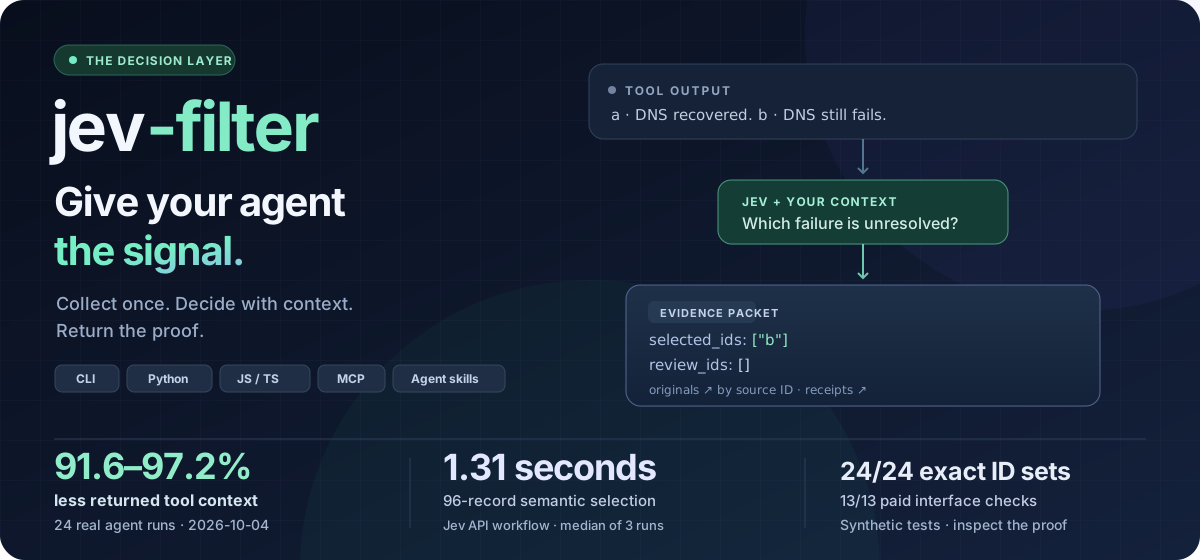
Jev Filter is an independent, MIT-licensed tool maintained by Apixly. It screens retrieved search results, code candidates, logs and command output against your task and supplied context, returning compact, typed evidence packets with source IDs and review cases. Every retained original remains recoverable by ID. Install the official npm package @apixly/jev-filter, or use its Python, JavaScript / TypeScript and read-only MCP interfaces.
Use it when many records need the same clear semantic judgment: which retrieved passages meet your evidence criteria, which code implements a behavior, or which correlated log events show a current failure. Your program collects and verifies; Jev makes the repeated judgments; your primary agent plans, reasons and writes. Installation · Common questions.
91.6–97.2% less returned tool context. Paid A/B on 2026-10-04: 24 real agent runs, three synthetic scenarios, two primary models and two repetitions per arm. Give your agent the relevant evidence; keep every original recoverable by ID.
Get started →Connect your agentInspect the evidence
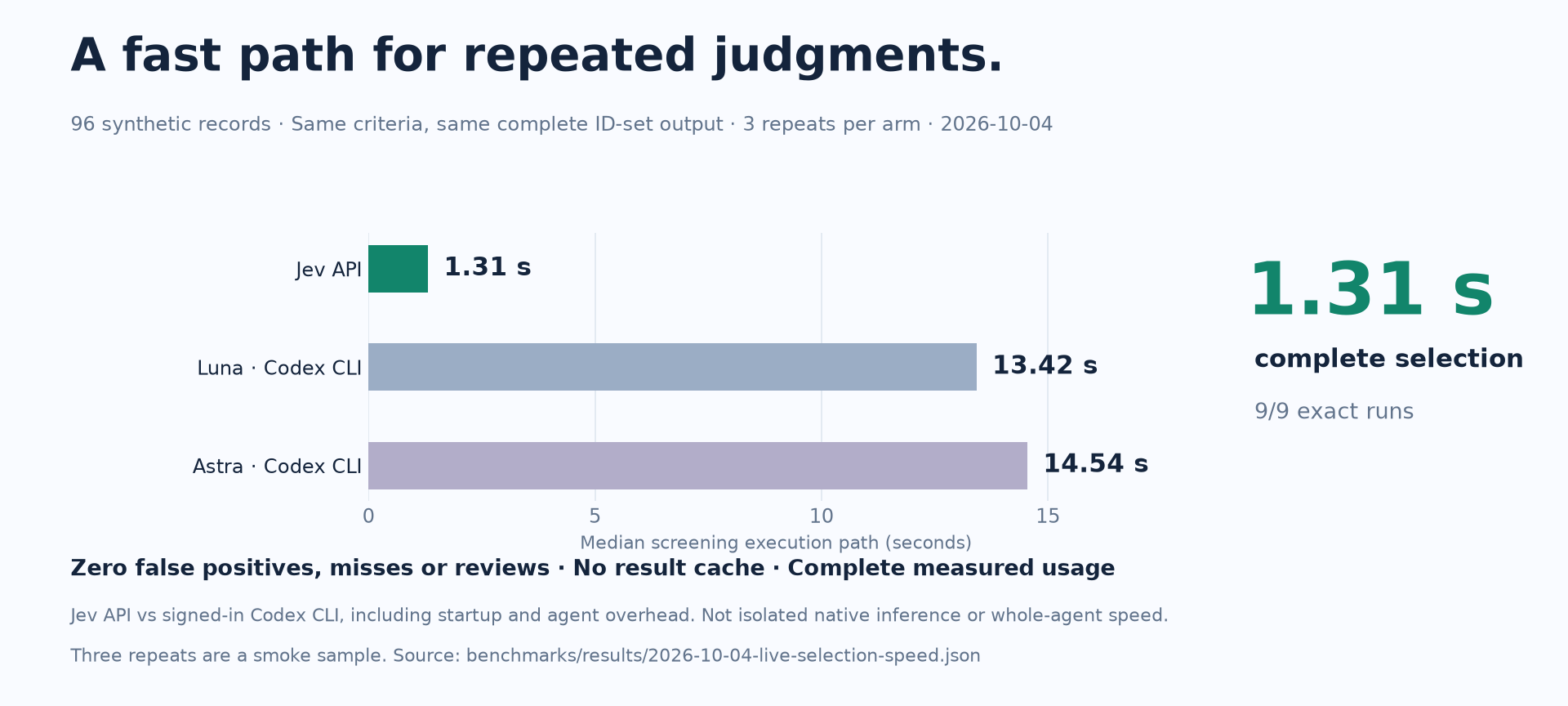
96 records. Same exact selections. 1.31 seconds.
Fast semantic selection, with the same answer to check. In the paid same-output test, all 9/9 runs returned the exact same 48 matching IDs from 96 synthetic records and two semantic conditions.
| Measured path | Median screening time | Exact complete runs |
|---|---|---|
Jev jev-1.13.0 · auto-batched API |
1.313 s | 3/3 |
Luna gpt-5.6-luna · signed-in Codex CLI |
13.421 s | 3/3 |
Astra gpt-6-astra · signed-in Codex CLI |
14.543 s | 3/3 |
This compares execution paths: CLI startup and the primary-agent turn are included, native model latency is not isolated, and no primary-agent continuation follows Jev. Primary paths use medium reasoning and no tools. Three repetitions per path are a smoke sample, not a whole-agent speedup or workload guarantee. Per-run data · Method and reproduction.
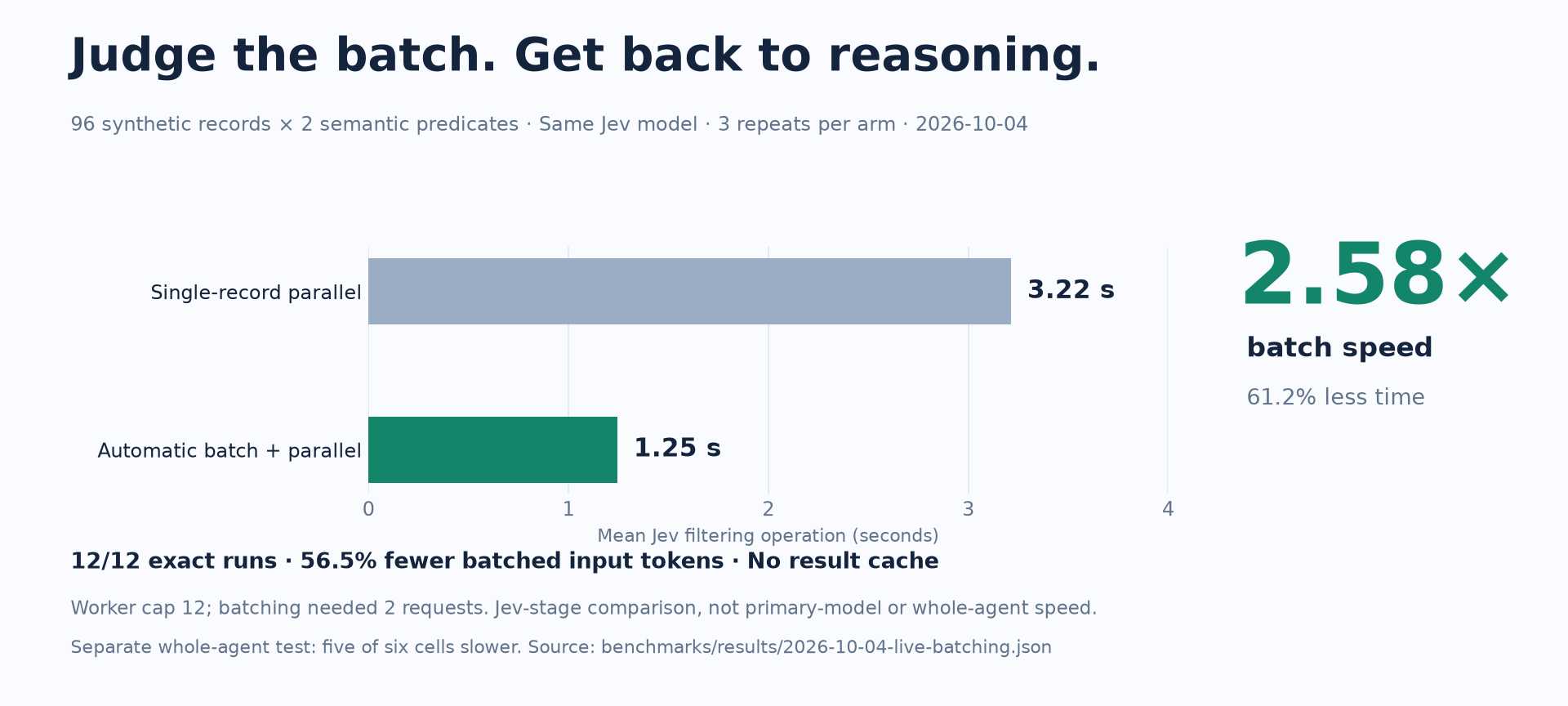
Batch the repeated work. A separate Jev batching test cut 96 requests to 2, used 56.5% fewer input tokens and achieved 2.58× filtering speed compared with single-record parallel Jev calls (3.215 → 1.246 s, 61.2% less time). All 12/12 runs were exact, without a result cache. Batch-stage evidence.
Put more reasoning behind less noise
91.6–97.2% less returned tool context, measured in 24 real agent runs on 2026-10-04: three synthetic scenarios, two primary models and two repetitions per arm. The filtered agent completed 12/12 operations; raw context completed 11/12. All 24/24 returned the exact expected ID sets.
| Attention for the hard part | Evidence you can recover | Interfaces you can trust |
|---|---|---|
| Collect and judge inside one program operation. The primary agent receives the selected evidence and unresolved IDs. | Keep originals by source ID, typed judgments and decision receipts. Source freshness and final checks remain independent. | 13/13 paid E2E checks passed on Python CLI, freshly installed published npm JS/native, official MCP, local extraction and survey. |
Find more relevant code. Native filtering after opt-in recall recovered 10/12 matches, versus 4/12 with exact candidates, with no false positives. Inspect the right changes. Bounded diff triage found all four target changes in both repetitions while returning 23.9% less context than retaining every file. Live source data and the added work.
The same core fits CLI, Python, JavaScript / TypeScript and read-only MCP, plus a portable agent skill. Automatic batching, at most 30 concurrent requests and no inference-result cache keep the repeated work in the program. Connect your agent.
Show the gains. Keep the trade-offs.
Context reduction is the strongest whole-agent result. Five of six measured cells were slower by 0.1–18.4%; cold API-equivalent cost ranged from 23.2% lower to 1.1% higher. Codex subscription billing is unknown. These small synthetic samples do not guarantee speed or savings.
Verified browser progress: observed scroll-container evidence changed the nested-scroll fixture from 0/3 to 3/3 completed runs under the same strict 0.55 / 0.10 policy. Six ordinary goal runs still require review. A model's DONE is usable only when an independent final check agrees. Current browser evidence, failed variants and recovery research.
All measurements · Install and run · Recorded synthetic workflows
Practical tutorials
| Task | Runnable tutorial |
|---|---|
| Filter retrieved search results before an agent reads them | Search-result filtering for RAG and AI agents |
| Find code by behavior inside a bounded lexical candidate set | Semantic code search for coding agents |
| Separate a current incident from a recovered historical failure | Correlated log triage with semantic filtering |
Each tutorial includes synthetic inputs, a caller-controlled contract, expected results and an offline preparation step. Inference requires a TypeSafe Jev API key and consumes provider usage; these examples are not new benchmark measurements.
Start with your task
| Your goal | Your next step |
|---|---|
| Install and see a selected record | Get started |
| Make a coding agent use Jev Filter | Five-minute agent quickstart |
| Capture tool output, find code or triage logs | Copyable task recipes |
| Use browser, desktop or survey execution | Hosted execution · Recorded runs |
| Define context, judgment and review policies | Context contract |
| Embed inference in an existing program | Integration guide |
| Connect JavaScript/MCP or evaluate saved judgments | Adapters and evaluation |
| Check quality, latency, usage and costs | Benchmarks and source data |
Reference and project
CLI reference · Architecture · Local usage dashboard · Distribution · Development and releases · README design
Inference inputs are sent to TypeSafe. exec runs your trusted command; hosted execution is restricted to program-enumerated actions. Keep identity, authorization, freshness and verification in your own workflow. Trust boundaries.
Jev Filter is an independent MIT project maintained by Apixly / JIA-ss. GitHub repository · 简体中文